
Replace Maine's outdated oil-fired power plant with modern batteries in grid-forming mode
NextEra seeks an exemption to Maine's new clean air regulations. The Maine DEP issued a draft order agreeing with NextEra. Batteries offer a superior technology solution for this polluting plant.
Quick View
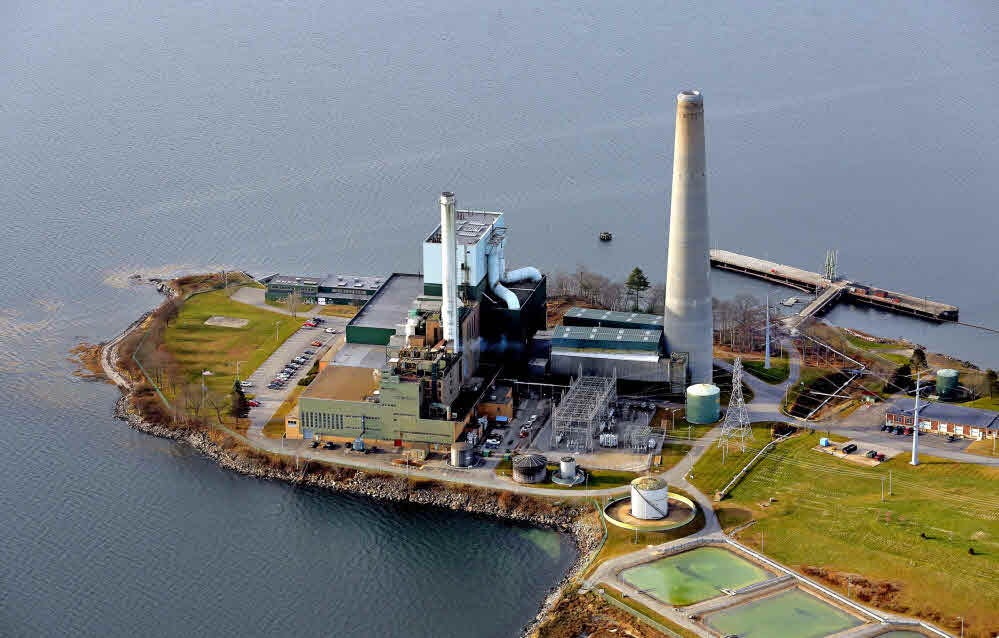
Does New England need the Wyman oil-fired power plant to meet occasional peak electricity demands in winter and summer? No, oil burners that slowly build steam pressure in large water boilers to drive rotating turbines are outdated for today’s dynamic electricity grid. Batteries in grid-forming mode provide greater flexibility, faster response, and more value to the grid.
The case for retiring the Wyman oil-fired plant
The old Wyman steam boilers have been polluting Casco Bay, Maine’s once pristine air, since the 1950s. Retired boiler units 1 and 2 were installed in 1957 and 1958 (almost 70 years ago), while the currently operating boilers, Units 3, 4, and 5, were installed in 1965, 1975, and 1977 (50 to 60 years ago).
These last-century plants were built for a different time with fewer air pollution limits and a simpler electricity grid.
Today, wholesale electricity markets and grid operations are complex. Independent power producers bid disparate resources from across New England, Canada, and New York into ISO-New England’s daily and real-time price auctions.
The power bids are ranked by price, with the lowest-priced units called to operate. The high-priced units, like the Wyman plant, stand idle until regional power demand exceeds available supply. The lowest-marginal-cost resources, such as wind, solar, hydro, demand response, and battery technologies, are first in the operating queue.
All the geographically dispersed technologies must coordinate instantaneously to keep the power system in balance. Fast, responsive control is best achieved with modern digital technologies, not with old turbines that need to build up steam pressure to become fully operational.
For these and the following reasons, NextEra and its regulators should consider alternatives to the Wyman power plant.
The oil-fired plant fails to meet new NOx emission limits.
Nitrogen Oxides (NOx), produced by burning oil, pose a health risk to communities. According to the U.S. Environmental Protection Agency (EPA):
Breathing air with a high concentration of NO2 can irritate airways in the human respiratory system. Such exposures over short periods can aggravate respiratory diseases, particularly asthma, leading to respiratory symptoms (such as coughing, wheezing, or difficulty breathing), hospital admissions, and emergency room visits. Longer exposures to elevated concentrations of NO2 may contribute to the development of asthma and potentially increase susceptibility to respiratory infections. People with asthma, as well as children and the elderly are generally at greater risk for the health effects of NO2.
NO2 along with other NOx reacts with other chemicals in the air to form both particulate matter and ozone. Both of these are also harmful when inhaled due to effects on the respiratory system.
To limit NOx health risks, Maine’s new NOx regulations went into effect on May 1, 2026, for oil-burning power plants. A primary objective of the lower NOx standards is to reduce ozone levels. The U.S. Environmental Protection Agency (EPA) and the Maine DEP seek to limit respiratory harm from ozone, including reduced lung function, inflammation, coughing, and throat irritation.
In late October 2025, NextEra sought an exemption from Maine’s new nitrogen oxide (NOx) emission limits at its Wyman Power Station. In a March draft order, the Maine Department of Environmental Protection (MaineDEP) agreed with the exemption request.
NOx exemptions are allowed under the “Reasonably Available Control Technology (RACT) regulations. Under these rules, a polluting plant may forego meeting stricter NOx limits if the investment in new emission-cleaning technology is not economically feasible.
NextEra’s RACT analysis made the case that new pollution control costs exceed the economic benefit of continuing to operate the intermittently used oil-fired plant. NextEra evaluated five emission-cleaning technologies with costs ranging from $30,000 to $1,530,000 per ton of NOx removed.
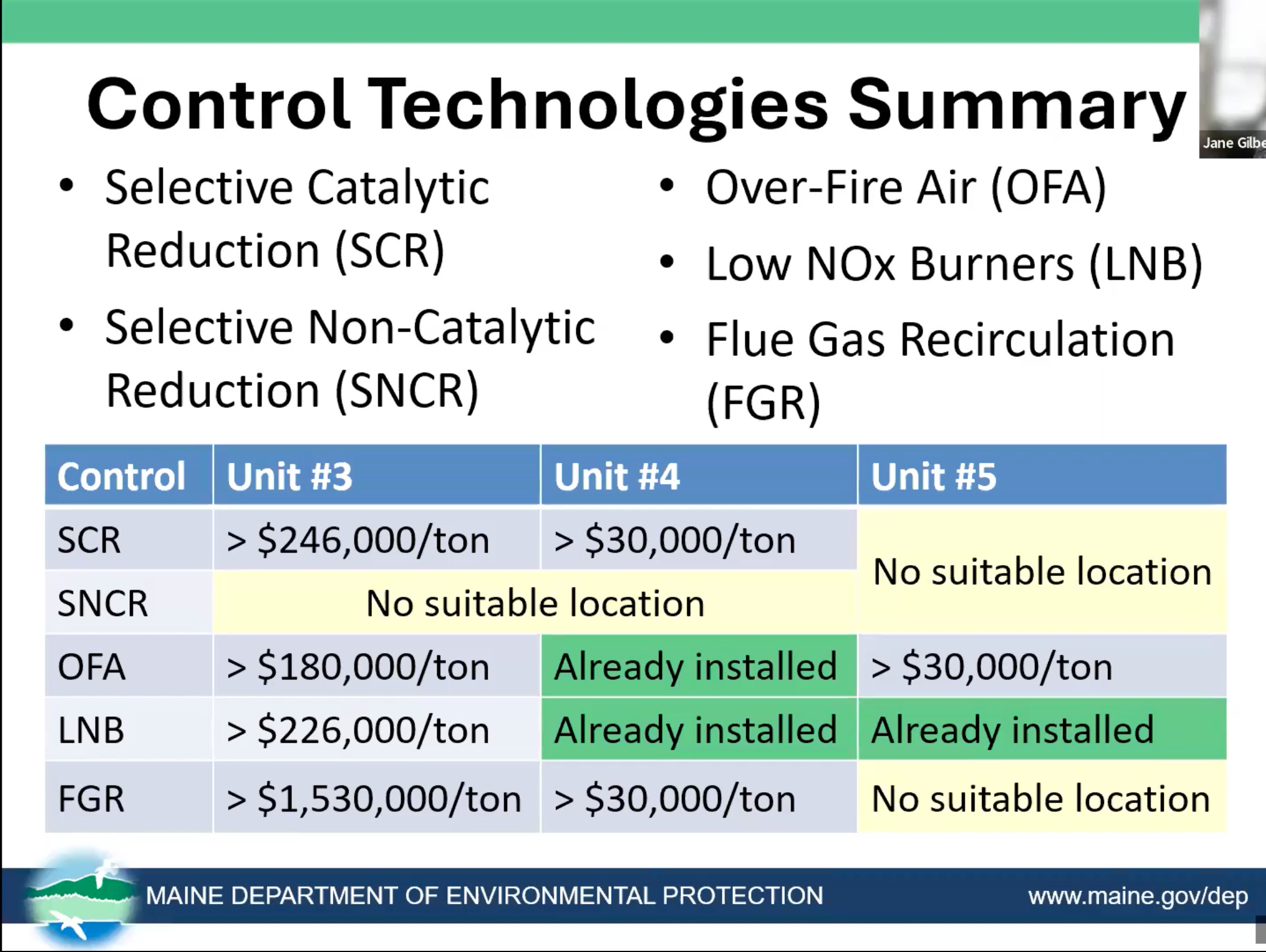
In NextEra’s exemption filing, the company expected the oil-fired plant would continue operating for 13 years, exceeding NOx pollution limits for more than a decade.
The plants are obsolete; NextEra planned to sell them a decade ago.
Around 2014, NextEra considered the plant obsolete and put it up for sale.
However, with ISO-NE capacity payments, the rarely operated plant receives sufficient revenue to stay in business. Capacity payments are paid to power plant owners to keep home heating and cooling equipment operating during extreme hot and cold spells, ensuring the region is supplied with life-saving electricity.
In the 2026/27 operating year, NextEra will receive capacity payments of about $22.6 million, and in 2027/28, about $31.2 million, solely to incentivize Wyman to stand ready to power up. These payments are based on Wyman’s winter-rated capacity of 727 MW.
The plant’s tax-appraised value has declined by $46 million since 2014.
A proxy for the plant’s changing economic value can be gleaned from the property tax records for Yarmouth, Maine. Property tax is separately assessed to the land and to improvements (the power plant).
The 117-acre land is appraised at $11,950,000 and has not changed since 2023.
In 2014, the plant’s assessed value was $50,000,000, 1,280% higher than the $3,907,700 assessed in 2025. Since 2024, the power plant’s value has declined by $8 million, a 2/3 reduction from $12,551,700.
The plants are expensive to operate, with an estimated fuel cost of $100,000 per hour.
Due to the Iran War, #6 oil prices have bounced up and down in the past few months. Overall, oil prices are 1.7 times higher than in mid-February, based on New York Harbor crude oil prices.
At maximum output, units 3, 4, and 5 consume a whopping 50,346 gallons per hour of heavy #6 fuel oil, according to regulatory filings. The largest unit, #3, burns a maximum rate of 41,930 gallons per hour. Assuming a $100-per-barrel oil price, unit #3 alone would cost $100,000 per hour.
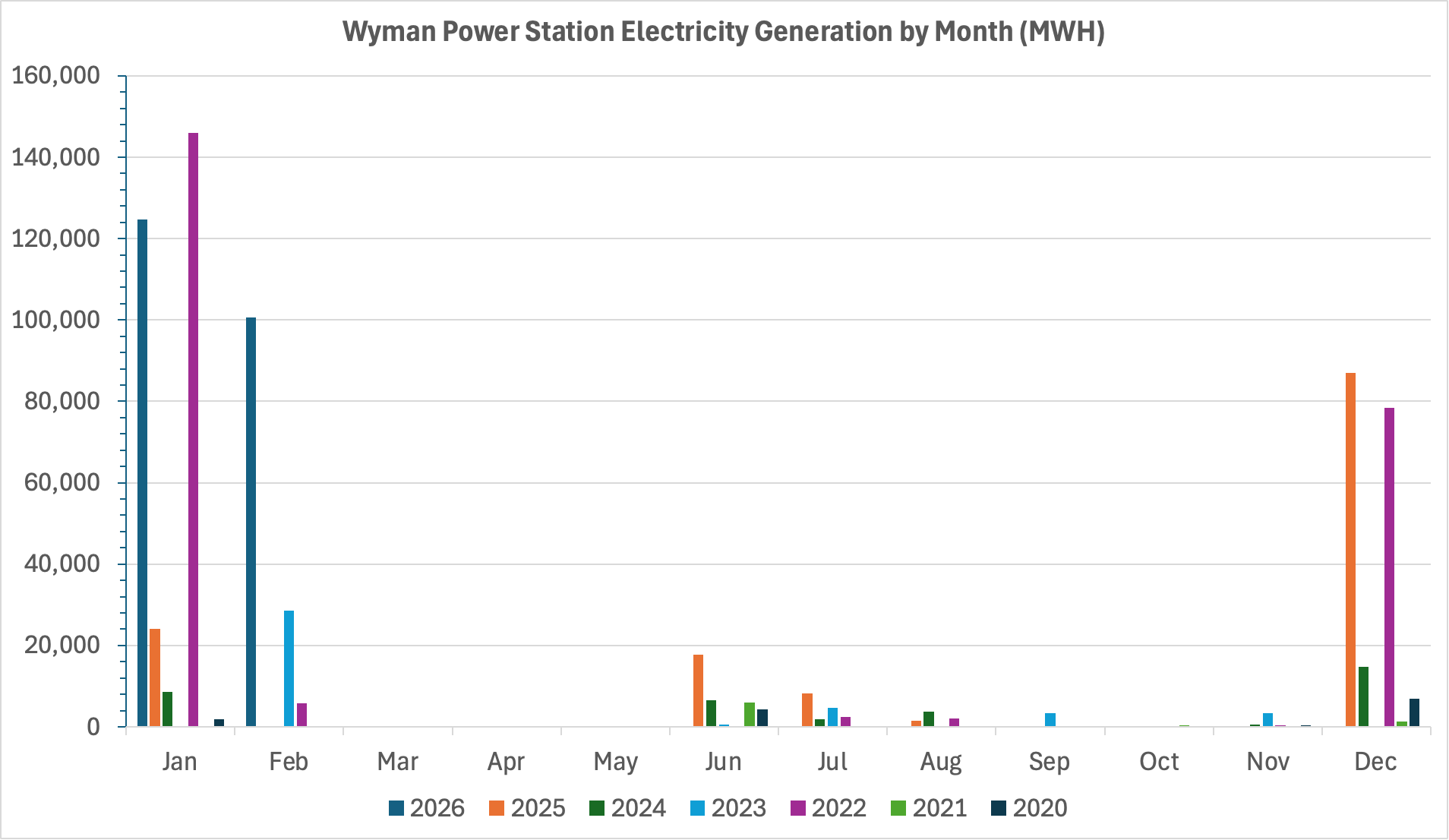
The plant’s generating units run infrequently.
Since the plant’s power costs are high, the units operate only during peak-demand periods under ISO-NE cost-based rules. The plants most often run on cold days in December, January, and February.
An alternative: utility-scale batteries in grid-forming mode
The most valuable Wyman Station asset is the 345-kV transmission line that connects Wyman to New England’s “interstate electricity highway”. This transmission line links Central Maine Power Company’s utility system to the bulk power grid in New Brunswick, Canada, and southern New England. Building an equivalent transmission line today could take more than a decade due to permitting, court, and legislative processes.
Batteries are a superior technology to benefit the high-voltage grid system.
Because of the rapid growth of wind and solar power, the region needs additional battery storage to absorb surplus renewable energy and release it when needed. The Federal Energy Regulatory Commission (FERC) and ISO-New England have been changing grid rules and operations to encourage greater battery installations.
Connecting batteries to the wholesale grid via the high-voltage electricity highway makes the Wyman site an ideal location to:
Deliver instantaneous energy to quickly respond to power fluctuations by absorbing and redistributing electricity, helping to keep the grid in balance.
Buy and store low-priced power, then resell it at a higher price to improve NextEra’s economics. For example, NextEra could store low-cost, abundant solar and wind energy during periods of surplus and resell it during periods when the regions’ power supplies are scarce and more expensive. This price arbitrage has the added benefit of causing market prices to converge toward a median price, reducing market price volatility.
Participate fully in the competitive wholesale electricity markets for capacity, energy, and ancillary services, increasing the site’s value to NextEra. Batteries with grid-forming inverters enable the full suite of services to protect the safe operation of the grid. Ancillary services, for example, help maintain grid stability against blackouts by regulating voltage and power frequency, and, if a blackout occurs, batteries provide blackstart capabilities (restarting power flow after a blackout).
Practical Questions about battery feasibility at Wyman.
Some considerations for a battery installation at the Wyman site.
Is there sufficient land to build an 800-MW battery system at Wyman?
Yes, subject to an engineering and permitting study, the site has sufficient land. An 800 MW lithium-ion battery installation can be built on 20 to 80 acres (0.03 to 0.1 acres/MW). The site is 117 acres according to property tax records, leaving 40-100 acres for a landscaped, vegetative screening buffer around the battery park. An alternative, lithium iron phosphate battery, which offers safety advantages over lithium-ion batteries but lower energy density, would require more space for an 800-MW project.
Could the batteries increase the property value for generating revenue?
Yes, subject to a market study, rather than just sitting idle waiting for the next cold or hot spell to power up the boilers and smokestacks, the clean batteries can participate as a full resource in ISO-NE’s competitive markets, increasing its revenue opportunities compared to just operating as a standby, and mostly idled peaking unit.
Could batteries operating in grid-forming mode replace a rotating generator?
Yes, large, heavy, spinning, synchronous turbines powered by fossil fuels are no longer needed to set and maintain grid voltage, a major concern for utility managers tasked with keeping the power on at all times.
Electronics in the form of “grid-forming inverters” (GFI) replace the older spinning generating equipment. This grid-forming mode (GFM) provides voltage regulation, frequency control, and synthetic inertia, all of which are necessary for a reliable power system.
For example, Eversource completed an early deployment of battery storage with grid-forming mode in Provincetown, MA. The system was planned as a non-wires upgrade to improve power reliability at the farthest end of Cape Cod. The project has been a success in keeping the lights on at the popular tourist area.
In a research paper, Grid Lab and the Energy Systems Integration Group analyzed the benefits of grid-forming mode batteries in protecting and managing power deliveries. Their summary:
The widespread adoption of [grid-forming mode, battery energy storage systems] is likely to bring significant value to ensuring the reliability, resilience, and affordability of the bulk power system. Digital infrastructure, national security, telecommunications, and every other critical infrastructure sector depend on stable and reliable electricity. The bulk power system is the largest machine in the world and is the foundation of modern society. Least-cost solutions that enable a more stable grid are not just an opportunity, they are a necessity.
Does NextEra support battery replacements for peaking generation?
Wyman’s owner, NextEra Energy, has long recognized the benefits of grid-connected battery systems. In 2015, NextEra’s then-CEO, Jim Robo, expected batteries would replace peaking units, such as the Wyman facility, after 2020. Why? According to NextEra:
Battery energy storage is transforming how power systems operate—bridging the gap between generation and demand with speed and precision. By storing excess energy when demand is low and releasing it when the grid needs it most, storage improves reliability, resilience, and cost control, [creating] a more stable grid.
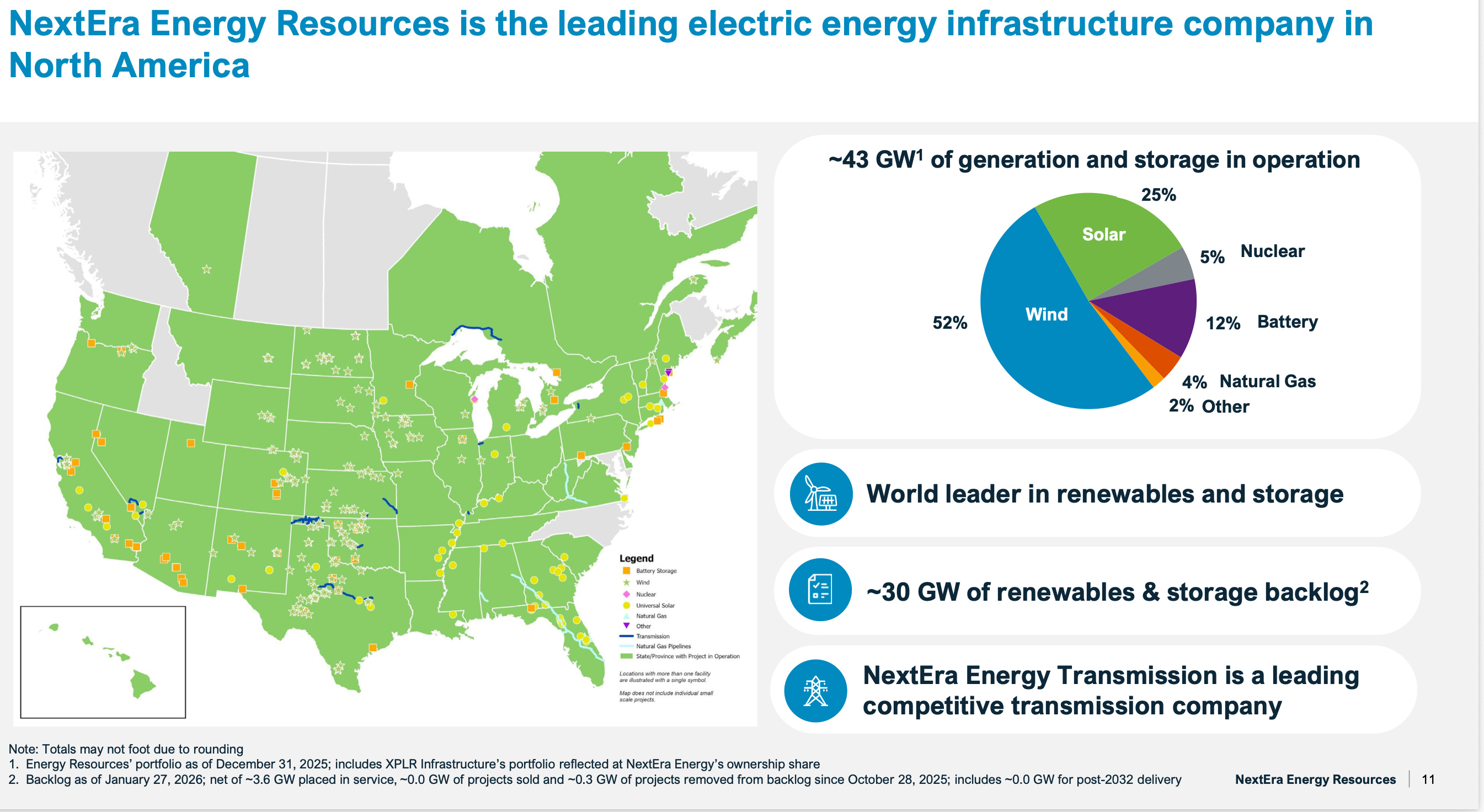
NextEra, the “Number 1 energy infrastructure investor,” has put its money and expertise into building and operating more than 50 U.S. energy storage projects. One of those projects, the 16.2-MW lithium-ion battery facility, is co-located with the oil-fired boilers at the Wyman station. The company has the money and know-how to expand well beyond 16 MW at the Wyman site.
The solution is clear: Retire and decommission the Wyman Plant.
Maine doesn’t have to choose between reliability and clean air. If legally possible, the DEP should have contingently approved the requested exemption, signaling that the days of oil‑fired peakers are numbered.
Furthermore, the DEP or other appropriate agency should have directed NextEra to prepare a plan with the Maine Public Utility Commission (MPUC), as appropriate, the Town of Yarmouth, ISO‑NE, and all authorities having jurisdiction to expeditiously permit and build a battery‑based replacement at Wyman’s site.
Swapping out the Wyman plant with batteries would protect coastal health, align with Maine’s climate goals, and still keep the lights on when power is most needed.
This decision would be a win-win for NextEra, ISO-New England, and the community surrounding Casco Bay, Maine.
Unfortunately, once the exemption is approved, it cannot easily be changed. As stated on the Maine DEP website:
NOx RACT requirements must be federally enforceable and part of Maine’s State Implementation Plan (SIP). Chapter 138 is included in Maine’s SIP.
After the Department issues a license that contains an alternative NOx RACT determination, that license will be submitted to the Environmental Protection Agency (EPA) as a site-specific SIP submission. If approved by EPA, the license containing the alternative NOx RACT determination will become part of Maine’s SIP. This makes the order’s requirements federally enforceable. It also means that the conditions of that license cannot be changed without EPA approval.
If the NOx exemption goes into effect, it is up to the political process to negotiate a win-win solution with NextEra and all relevant parties, returning Casco Bay to its once-clean-air beauty at all times of the year.

Additional Reading
Battery Storage for Fossil-Fueled Peaker Plant Replacement, A Maine Case Study, April 2024, by Clean Energy States Alliance and Strategen.